2024 Newsletter
In 2024, ISVS organized national and international events to investigate the roles of values and spirituality in today’s world. There is increasing evidence that values with a foundation in spirituality significantly impact global developments, and the ISVS mission to analyze them is highly relevant.
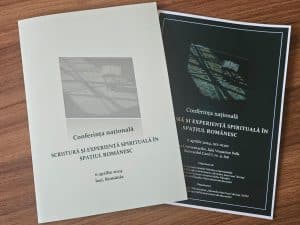 On April 6, ISVS organized the National Conference “Writing and Spiritual Experience in the Romanian Space,” which outlined more than academic openings. The presentations and debates focused on the purposes of writing in the horizons of Romanian spirituality and beyond. Continuing the investigation from the Conference organized in October 2023, “Beyond Writing: Spiritual Experience as Transcending the Text,” the theme of this conference was a natural deepening of the implications related to this dimension of writing.
Marian Vild presented on the Paisian School and spiritual experience in the Romanian Cultural Space, and Alexandru Barna on the Translation of Saint Dionysius the Areopagite or on Theology and Philosophy in Romanian (both from the Faculty of Theology of the University of Bucharest). Savu Totu (Faculty of Philosophy, University of Bucharest) presented on The Divine Light in the Writings of Saint Simeon the New Theologian from the perspective of Father Dumitru Stăniloae. There were also presentations from the Department of Philosophy at the “Alexandru Ioan Cuza” University of Iași: Ioan Alexandru Tofan on Language and Silence with Father Andre Scrima, and Ioan Bârgăoanu on the Writings of Saint Simeon the New Theologian, an experiential guide to Romanian Spirituality. Dan Gabriel Sîmbotin (Institute for Economic and Social Research “Gheorghe Zane,” Romanian Academy, Iași Branch) spoke on Romanian Culture in the Far East and the Limits of Intercultural Dialogue. The debates at the Round Table outlined innovative perspectives on the multivalence of writing’s purposes in spiritual experience. The event was organized in collaboration with the Department of Philosophy, “Alexandru Ioan Cuza” University of Iași, and the Research Center for the History of Philosophical Ideas of the Faculty of Philosophy, University of Bucharest.
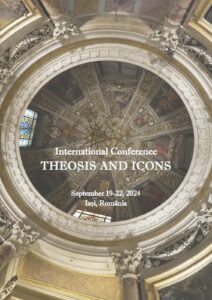 Between September 19 and 22, ISVS organized the International Conference “Theosis and Icons” in collaboration with the Cambridge Centre for the Study of Platonism, Cambridge University. The event explored perspectives on Deification in connection with the Icons.
This relationship was investigated anthropologically, aesthetically, epistemologically, and theologically in presentations of exceptional relevance for deepening an innovative research topic.
In the opening, the Keynote Lecture was delivered by the director of the Cambridge Centre for the Study of Platonism, Douglas Hedley, titled “Theosis and the Play of Imagination.” Also from Cambridge University were Hadi Fakhoury, with The Iconic Ontology of Henry Corbin, and Francesco Aresco, with Byzantine Resonances and Divergences: Mirandola`s Devotion and Mannerism in Sixteenth-Century Art. Gareth Polmeer from The Royal College of Arts lectured on Iconicity and Meaning: Icons, Arts and Digital Age. Presentations of exceptional relevance for the relationship between Theosis and Icons were given by Frederick Lauritzen, from the Scuola Grande di San Marco, with Byzantine Theosis between Ontology and Platonism, and Avedis Hadjian, from the École des Hautes Études en Sciences Sociales, with The Boundaries of Transcendence: The Armenian Church, Icons, and its Unique Path to Theosis. Osman Bilen, Dokuz Eylul University, gave a talk on Imago Dei or Imitatio Dei, Daniel Codrescu, Iconograph, Bucharest, with From Mystical Experience to Matter from a Practical Iconographic Perspective, and Ioan Alexandru Tofan, Alexandru Ioan Cuza University, on Icon as Experience: Marian Tarangul.
The Round Table, moderated by Douglas Hedley and Dan Chițoiu, outlined new perspectives and avenues for further research on a topic proving highly productive.
These events were sponsored by The Institute for the Study of Values and Spirituality (ISVS) and were organized by Dan Chițoiu (ISVS&UAIC) and Corina Domnari (ISVS&UAIC).
 The ISVS YouTube Channel has videos from the Institute`s Lectures, Conferences, and Seminars, as well as a Documentary, An American Experience of Romanian Hesychasm:
https://www.youtube.com/@institutevaluesandspirituality/videos
MEΘEXIS Journal of Research in Values and Spirituality, the ISVS publication, had two Special Issues in 2024, including valuable contributions from experts worldwide.
 The May Issue of Methexis Journal had as its topic “Symbolic Codes and Cultural Identity Frames,” including in its pages original contributions with relevance for interpreting the role of symbolic codes in shaping cultural identity: Mariam Vardanyan (Yerevan State University), in Artistic Features of Armenian Liturgical Objects Abstract, discusses artistic features of the ritual objects of the Armenian Church, interpreting them according to the types of objects, focusing on the ritual objects used during various rituals in the Armenian church, with their types and artistic features developed over time. Avedis Hadjian (École des Hautes Études en Sciences Sociales), in Notes on the Origins and Symbology of the Conical Dome in Armenian Church Architecture, sees that soon after Armenia became the first state to adopt Christianity, its architects developed a new sacral architecture to accommodate the liturgical requirements of the new faith, with a liturgy that made larger indoor spaces necessary, unlike the pagan temples, which essentially functioned as repositories of the sculptures of gods, the most characteristically outstanding feature became the Conical Dome.
From a different perspective, Umut Asanova (Eurasian International University) and Asel Abdurakhmanova (National Academy of Sciences of the Kyrgyz Republic) propose an investigation into What Ultimate Truth is Hidden Beyond the Symbolic Code of Cultures, invoking the examples of some legends and myths included in famous Chynghyz Aitmatov’s novels. Ikechukwu Monday Osebor (University of Delta, Nigeria), in Inclusive Symbolic Frames and Codes Shaping Cultural Identity and Cultural Values, points out that the moral implications of symbolic codes about cultural identity frames may include misinterpretation, stereotyping, and marginalization. Symbolic moral codes emphasize the dynamic nature of cultural identities and the need for inclusive representations to foster understanding and respect across diverse cultural groups. The issue includes Paniel Reyes Cárdenas (Oblate School of Theology, USA) paper on The Experience of Deification in the Spiritualities of the Night: from Early Eastern Christianity to Saint John of the Cross, showing the continuous trend of values and experiences proposed by what we can call `Spiritualities of the night`: the knowledge of God is concealed to the mind unless the human person undergoes a process of purification and union with God in love, this culminates in ecstasy as experience of ultimate union.
 The November Issue of MEΘEXIS Journal focused on “Artifacts in Cultural Identity and Spiritual Practice”.
Jānis Ozoliņš (University of Divinity, Australia), in his paper Interpreting Aboriginal and Torres Strait Islander Art and Artefacts, sees that artifacts must be understood not simply as objects that can be described in terms of their physical characteristics and the use made of them, but also as objects that have cultural, historical, and religious significance. We should see Australian artifacts not just as having utilitarian purposes, but as immersed in an Aboriginal world in which they will have different meanings, if not uses, for different Aboriginal communities. It is also important to stress that every Aboriginal community has prohibitions on outsiders knowing certain sacred things that only designated community members may know. Unless individuals are members of that community, they will not be privy to their secret matters. This is to preserve the value of certain ceremonies, rituals, and specific designs, totems, and objects. On the other hand, in the African context, Ernest Beyaraza (Independent Researcher, Emeritus of the Catholic University of Eastern Africa), in Artifacts in Cultural Identity and Spiritual Practice. Disjointedness of Traditional and Modern Artifacts, Symbols and Signs with Living Examples from Africa stresses that man and nature are not merely observable physical phenomena. Humanity combines physical, mental, intellectual, and spiritual nature. This tripartite phenomenon is reflected in cultures. Nature, too, is not inanimate clay from which cultural objects are modeled, a typical mistake of naturalism and scientism. Man, and nature are different entities but complement each other. There is a supra-natural reality beyond them. Thus, artifacts are made about personal needs, natural dictates, and spiritual roles. Artifacts also reflect human relations. Human contact initiates cross-fertilization of ideas, concepts, perspectives, aspirations, practices, artifacts, and other aspects of life. Such a perspective is illustrated well in Ikechukwu Monday Osebor‘s (University of Delta, Nigeria) paper on “Ofo” in Cultural Identity and Spiritual Practice in Owa Culture. Ofo is a cultural artifact deeply rooted in the traditions of the Owa people, part of the Ika-Igbo nation in Delta State, Nigeria. It represents personal accomplishment, power, and individual success, often associated with the male’s personal deity or “Chi.” Ofo is typically a wooden stuff carved from a specific type of tree believed to have spiritual significance, serving both spiritual and social functions. The wood is usually polished and may be adorned with symbols or decorations. It often features intricate carvings, including anthropomorphic figures, animals, or geometric patterns. These carvings are not merely decorative; they carry symbolic meanings related to the owner’s lineage, status, or spiritual beliefs. Another excellent contribution to the Issue`s topic is André Bueno‘s (State University of Rio de Janeiro, Brazil) The Book as a Cultural Artifact in Brazilian Spiritism, which examines the religious doctrine of Christian spiritualism that emerged in the 19th century in France but achieved significant expansion in Brazil, becoming one of the primary religious expressions in the country. Brazilian Spiritism places great emphasis on study as a form of knowledge and development of the doctrine, making the Spiritist book central to constructing a Spiritist cultural pedagogy. Bueno sees the Spiritist book mainly as an artifact with diverse functions in the ongoing transformation of the Brazilian Spiritist movement.
The issue also included Landscapes of Transcendence: The Aniconic Sacredness of Mountain Geographies (Sanjeeva Guneratne, KDU, Sewanagala, University of Moratuwa, Faiz Marikar, KDU, Sri Lanka) and Falling in Love (Patrick Giddy, University of Kwazulu-Natal, South Africa).
The content of these issues of MEΘEXIS Journal and the others published so far can be read at https://methexisjournal.com/.
Editors-in-Chief: Dan Chițoiu, Corina Domnari