2025 NEWSLETTER
In 2025, the Institute hosted both in-person and virtual events to examine the complex role of values and spirituality in today’s world. The ISVS publication, MEΘEXIS Journal of Research in Values and Spirituality, published two issues that featured research on key topics in our rapidly changing global scene. Growing evidence indicates that spirituality-based values are crucial in shaping global trends, highlighting the importance of ISVS’s goal to analyze these developments.
ISVS LECTURE SERIES

On February 12, the Institute welcomed Dan Gabriel Sîmbotin, Gheorghe Zane Institute for Economic and Social Research, Romanian Academy, Iași Branch, as a guest speaker in the ISVS Lecture Series. He presented on the topic Tradition, Spirituality, and Education: South Korea Case Study (Tradiție, Spiritualitate și Educație. Studiu de caz: Coreea de Sud). The Lecture, held in Romanian, can be watched at https://www.youtube.com/watch?v=wSqA2hVv-po.
INTERNATIONAL SEMINAR

On June 13-15, the Institute for the Study of Values and Spirituality and the Palamas Seminar, in collaboration with Alexandru Ioan Cuza University of Iași and the University of Bucharest, organized the International Seminar on St Gregory Palamas Today: Experiential and Epistemological Pathways at Casa Hozeva, Neamț Monastery, Romania.
We had been most honored by the participation of Norman Russell, University of Oxford, who delivered a Keynote Lecture on Palamite mystical theology and the Church in the last century of Byzantium. In the Opening Session, Mircea Dumitru, Vice-President of the Romanian Academy, delivered a Keynote Presentation on Palamas, in his own time and now, from a modal metaphysical standpoint.
Conference panels gathered insightful presentations, followed by discussions and debates, delivered by: John Farina (George Mason University, USA), Gregory Palamas: Experience, Secularization, and Theology; Frederick Aquino (SMU Perkins School of Theology, USA), Ascetic Formation and the Training of Spiritual Perception in Maximus the Confessor; Constantinos Athanasopoulos (FHEA, UK), Moore’s wrong conclusions regarding Florovsky’s Logical Relativism; Fr. Manuel Sumares (Portugal), Kantian antinomies and Palamite synergies: The Inner-Workings of Bulgakov’s Philosophical Theology; Fr. Marian Vild (Bucharest University, Romania), “For the kingdom of God is not in word, but in power”. Charismatic theology and theological discourse in the thought of St. Gregory Palamas; Fr. Alexandru Barna (Bucharest University, Romania), Philosophy in the Making of Theology. The Palamite Triads in Defense of Hesychast Fathers; Viorel Vizureanu (Bucharest University, Romania), The Role Played by the Palamite Doctrine in the Revival of Christian Life in the Work of Saint Dumitru Stăniloae; Dan Chiţoiu (Alexandru Ioan Cuza University & ISVS Institute, Romania), Levels of Perception and the Question of Truth in Palamas and Hesychast Tradition; Corina Domnari (Alexandru Ioan Cuza University & ISVS Institute, Romania), Experiential and Knowledge Pathways: Depiction of Relational Self in St. Gregory Palamas; Victor Nechayev (Göttingen University, Germany), Hesychasm and the Psychology of Self-Transcendence: Empirical Insights into theosis from Athonite hermits; Alessia Brombin (Pontifical University of the Holy Cross, Italy), Hesychast Prayer as Transformative Dialogue: Dumitru Stăniloae Integration of Palamite Theology in Social Praxis; Dimitry I. Makarov (Sociological Institute of the Russian Academy of Sciences), Gregory Palamas’ Treatise against Gregoras: Problems of Contents and Style; Ioan Daniel Manolache (Bucharest University, Romania), Latin Elements in the Theology of St. Gregory Palamas: Revisiting a Historical Controversy; Fr. Ioan Bârgăoanu (Alexandru Ioan Cuza University, Romania), Spiritual Experience and Discursive Expression in Simeon the New Theologian; Laurențiu Gheorghe (Bucharest University, Romania), Technology and Knowledge of God in concrete circumstances of Life; Olena Gruba (St Thomas Aquinas Institute of Religious Studies, Ukraine), Silence at the Edge of Language: From Hesychastic Mysticism to Communicative Philosophy; Chris Ioniță (Bucharest University, Romania), Agency, Ownership, and Selfhood. Epistemological Remarks Regarding Micro-Phenomenology and Theology; Tudor Avrigeanu (Romanian Academy), “Within the Jurisprudence, we also have to rise with the mind into the heart.” On the Possibility of Legal Hesychasm in the Contemporary South-Eastern Europe.
These events were sponsored by The Institute for the Study of Values and Spirituality (ISVS) and were organized by Dan Chițoiu (ISVS&UAIC) and Corina Domnari (ISVS&UAIC).
 The ISVS YOUTUBE CHANNEL has videos from the Institute`s Lectures, Conferences, and Seminars, as well as a Documentary, An American Experience of Romanian Hesychasm:
https://www.youtube.com/@institutevaluesandspirituality/videos
ISVS PUBLICATION – Issue 8 & 9 of MEΘEXIS Journal
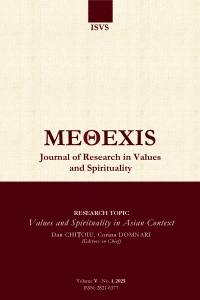 ISSUE 8 of MEΘEXIS Journal focused on Values and Spirituality in Asian Contexts.
Exploring the complex relationships between values and spirituality in Asia, the Issue focus covered Chinese and Indian cultural regions, as well as a remote part of the Pamir. The research gathered in the Issue assesses major cultural and spiritual areas across Asia and examines borderlands and remote cultural zones. These studies shed light on the profound connections among spiritual codes, social norms, and cultural identity in Asia.
Wei Hua and Cao Yuan, in Ding: Chinese Cultural Artifact Embodying the Thought of Unity between Heaven and Man, analyze a significant cultural artifact that reflects early Chinese philosophical ideas. Understanding ding symbolism enhances human insight and practical experience, supporting personal growth and the ultimate pursuit of complete unity with heaven, a core element of Confucian spirituality. Prakriti Mukherjee‘s article, Rosary as Artifact: From Religious Symbolism to Scientific Implications, examines the importance of prayer beads by comparing Indian and Chinese traditions. In Indian Buddhism, Japamala, comprising 108 beads, is used for mantra recitation, breath counting, and enhancing mindfulness and focus, highlighting the transformative power of mantra practice. The article explores how prayer beads help unite mind, body, and spirit, connecting the physical and spiritual realms, while also considering ethical issues related to their use in moral development and virtue cultivation. Pukhrambam Julia Chanu and L. Bishwanath Sharma explore in Indian Culture and Western Thoughts how Indian culture maintains unity amid the country’s diversity. They assess the effects of Western education and Christian missionaries on Indian society and trace the development of Indian socio-political ideas and institutions. Pandit Deendayal Upadhyaya’s concept of Integral Humanism posits that the traditional Indian view of the nation and nationality stems from a worldview that emphasizes creative harmony and interconnectedness. Syamala K. in Bhagavad Gita’s Vision for a Harmonious Society: Ethics, Values, and Social Justice, highlights that the Bhagavad Gita teaches that one should develop one’s ideals in accordance with one’s societal role. The central teaching is nishkama karma, a form of selfless action. Practicing this helps individuals remain grounded in higher reasoning and uninfluenced by passions and emotions. It advocates working for humanity’s benefit with detachment and without selfish motives, for the preservation and welfare of society.
Maxim Mikhalev in Khalifa of Pamir, Custodians of Knowledge, explores the social and spiritual roles of local religious leaders in the Pamir Mountains. This secluded region, situated at the borders of China, Pakistan, Afghanistan, and Tajikistan, is home to several ethnic groups that have long practiced Ismailism, an esoteric branch of Shia Islam. Local leaders called Khalifa serve as community guides, addressing villagers’ issues and preserving secret Gnostic knowledge of Ismailism. Field research conducted by Maxim indicates that these teachings resonate with the local people’s innate desire for knowledge and loyalty to spiritual understanding.
In a separate section, Savu Totu explores Divine Wisdom and Human Wisdom in the Divine Name by St. Dionysius the Areopagite. He highlights that the image of divine names helps us understand how to attain godly wisdom through the `third way’, a unique process involving our reason and mind. The connection between divine and human wisdom is viewed as the link between spiritual experience and philosophical knowledge, always involving the transfiguration of human reason, mind, and senses.
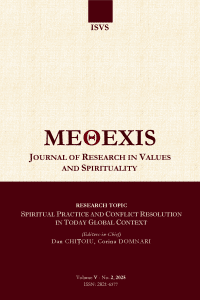 ISSUE 9 of MEΘEXIS Journal had as its research topic Spiritual Practice and Conflict Resolution in Today’s Global Context.
War is not only overt, such as armed combat, but also includes covert struggles, such as internal tension. A spiritually oriented perspective shifts our understanding of reality, allowing us to see conflicts and tensions differently by illuminating their underlying mechanisms, sources, and possible solutions.
Andrei Christian Temistocle’s article, A Scripturistical and Cultural Perspective on War; Saint Gregory Palamas and the Contemporary Patristic View on Conflicts in the Plan of the Unseen War, explores, from a spiritual viewpoint, the causes of conflicts, their consequences, and the solutions proposed over time to address conflicts at personal and community levels. Tangible conflicts or wars are often preceded by unseen conflicts at the inner level, which can be more subtle and sometimes more challenging to detect. The paper emphasizes Gregory Palamas’s views on personal and social conflicts, focusing on processes in the spiritual realm, above the material world, and, secondarily, in the physical world where conflicts manifest. The discussion explores the potential for peace and emphasizes the importance of humanity’s future in the 21st century. Ștefan Soponaru, in The Flames of War and the Burning Bush of Prayer: A Spiritual Response to the Problem of War, emphasizes how a modern Romanian spiritual movement responded spiritually to war. Growing up in a country that suffered from World War II and the Communist regime, this movement aimed to address conflict through Orthodox traditions. The Burning Bush was a hesychast movement composed of intellectuals, clergy, and monks committed to spiritual healing and conflict resolution by living authentically within the church’s way of life. Encounters with war and historical terror led members to develop an eschatological consciousness. Through hesychast practice, members worked to heal their personal and collective relationships with God, themselves, and others. During a period of widespread atheism, the movement subtly conveyed the message of peace and unity in Christ through its members’ actions.
Konstantinos A. Diamantopoulos‘s contribution, The Battle of Good and Evil Through the Rite of Exorcism According to Greek Christian Orthodox and Roman Catholic Perspectives examines the challenging nature of exorcism and proposes viewpoints for further academic research. Exorcism is described as a spiritual case of warfare, and despite the worldwide incidents that have occurred, exorcists don’t discuss or reveal the full spectrum of this kind of battlefield. He notes that without relevant sources, theological research and scholarship are becoming increasingly impoverished. In his paper, Konstantinos analyzes the differences between the Christian Orthodox and Roman Catholic exorcism processes. The Orthodox tradition follows a traditional spiritual framework that does not explore the diverse aspects of demonic manifestations. Conversely, the Roman Catholic Church has established a comprehensive approach to exorcism. Nevertheless, the existing research literature is limited, and more scientific investigation is needed in this area. Discussing twentieth-century views on evil and the role of spirituality in discerning it, Tone Svetelj assesses hatred and rehumanization through the perspectives of Hannah Arendt and Simone Weil. He does so in his article, From the Banality of Evil to Spiritual Attention: Emancipation from Hatred and Rehumanization. Tone examines Arendt’s view of hatred through its political and systemic expressions, notably her concept of the banality of evil, which links widespread complicity to thoughtlessness, a failure of critical and empathetic engagement. Her approach to peace involves inner spiritual liberation achieved through attention, decreation, and acceptance of necessity. Arendt calls for vigilant public engagement, while Weil focuses on profound inner transformation. Together, they provide a comprehensive framework for understanding and overcoming hatred, indicating that true rehumanization requires both external political action and profound internal change. The three totalitarian regimes and two world wars of the 20th century prompted deep reflection on the nature of hatred and the pursuit of peace. Achieving peace and freedom requires not only political action but also a profound inner transformation and the active cultivation of humanity within oneself and in relationships with others.
K.L. Sharma proposes such an approach in Nididhyasana as Existential Assimilation: From the Brhadaranyaka Upanishad to Contemporary Philosophical Counselling, which explores the classical Advaitic concept of Nididhyasana (deep contemplation) by tracing its origins in the Brhadaranyaka Upanishad and examining its potential applications in contemporary philosophical counselling. Nididhyasana transcends mere meditation; it entails the profound assimilation of truth, following the stages of Sravana (hearing) and Manana (reflection). Sharma views Nididhyasana as a potent tool for existential transformation, particularly in contexts where philosophical clarity and ontological anchoring offer a viable path beyond modern psychological frameworks. The Issue included a case study on spirituality during pivotal moments in history.
George Stoukis, in The Contribution of the Orthodox Church and the Clergy to the Greek War of Independence (1821): The Case of the Monasteries of Boeotia, discusses how the 1821 Greek War of Independence was a significant milestone in Greek history and the beginning of Modern Hellenism. This conflict achieved the long-sought freedom and independence of the Greek people. The Greek Orthodox Church played a vital role both before and during the revolution, helping establish conditions for the emergence of the modern Greek nation. Stoukis highlights the importance of Orthodox monasteries and clergy in the fight for liberation, especially in Boeotia, emphasizing the strong backing from the Church and monastic communities for the independence movement. The church offered moral support and substantial material aid to the insurgents.
The Issue includes Mikael Stamm‘s paper, The Fate of the Excluded Middle Between Truth and Nescience: Mantras and other Senseless Truths in Indian and Western Philosophies explores language’s relation to the concept of a fundamental truth. Stamm employs a mapping method to organize key ideas within their contexts, dividing them into two areas: primordial truth and its absence, each reflecting and excluding the other. These exclusions highlight the difficulty of reconciling the two. Truth expression methods include Indian mantras, described as self-validating, necessary, and essentially meaningless, revealing a fundamental aspect of original speech that transcends speakers, content, and communication. The ‘excluded middle’ issue is considered by examining statements about primordial truth and recognizing the challenge of expressing such truth. Stamm proposes that understanding truth requires rejecting meaningful language of the ‘middle,’ which merely reflects a transformative event. This perspective reduces the importance of meanings and creates space for the voice of Being.
The content of these issues of MEΘEXIS Journal and the others published so far can be read at https://methexisjournal.com/.
Editors-in-Chief: Dan Chițoiu, Corina Domnari